Colorimetry Research CR-100
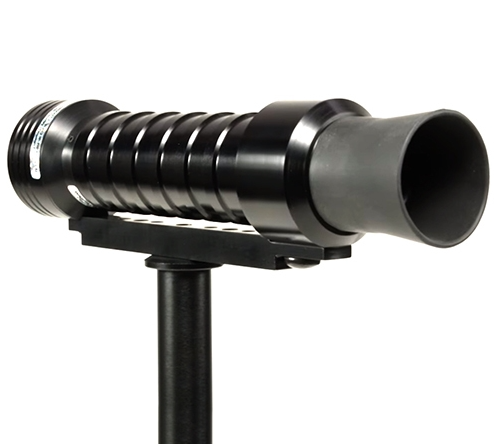
CR100The Colorimetry Research CR-100 is a high quality colorimeter designed specifically to work with virtually any display technology. The CR-100's machined aluminum and steel housing coupled with a completely solid state design ensure excellent durability while keeping the probe incredibly compact and lightweight (just 12 ounces / 340 grams). What sets the CR-100 apart from other colorimeters are its high quality tristimulus filters. Every CR-100 goes through a strict quality control process including measurement of every tristimulus filter with a double monochromator to ensure the following performance benchmarks are attained:
| Guaranteed | Typical | |
| Y (Photopic) | ≤ 2.0% | 1.4 - 1.8% |
| Xr (Red) | ≤ 3.0% | 2.3 - 2.7% |
| Xb (Red under Blue) | ≤ 1.2% | 0.8 - 1.0% |
| Z (Blue) | ≤ 3.5% | 2.2 - 2.7% |
The CR-100 can be used with the CRI Application for manual measurement and logging. It is also compatible with FSI's GaiaColor AutoCal for DM, XMP, and XMP C series monitors, LightIllusion's ColourSpace*, and Portrait Display's Calman* allowing for full 3D LUT based calibration of Flanders Scientific monitors.
New CR-100 purchases will come equipped with matrices for current FSI monitor models including:
- DM160
- DM170
- DM211
- DM220
- DM231
- DM240
- DM241
- DM242
- XMP270 & XMP270C
- XMP310 & XMP310C
- XMP550 & XMP550C
- XMP551
- XMP650
- XMP651
The CR-100 can be used to measure a wide variety of display technologies and utilizes the Four-Color Matrix Method to calibrate the probe for use with specific display types/spectral distributions. The Four-Color Matrix Method, developed by the National Institute of Standards and Technology (NIST), improves the accuracy of tristimulus colorimeters for measurements of color displays and has been verified to be appropriate for cathode rays tubes (CRTs), liquid crystal displays (LCDs), and organic light emitting diodes (OLED) displays.
*Calman is sold separately.
*ColourSpace is sold separately.
Features at a Glance
- Compact & Rugged — Constructed using machined aluminum and stainless steel and weighs only 12 ounces (340 grams). Completely solid-state with no mechanical shutter or moving parts.
- Accurate Filters — Each CR-100 goes through a strict quality control process. Every tristimulus filter is measured using a double monochromator to verify that the f1' error is within the maximum f1' errors guaranteed.
- Large Spot Size — The measurement spot size is 23.0 mm at the end of the rubber hood and 31.7 mm at 100 mm from the end of the hood.
- Fast Captures — The fastest measurement exposure time is 1 msec.
- Display Flicker Measurements — Proprietary hardware and software for fast sampling of display luminance to compute flicker levels (modulation amplitude) and dominant flicker frequency components.
- Response Time Measurements — Temporal captures at user-selectable sampling rate, suitable for analyzing response time as specified by the Information Display Measurements Standard (IDMS).
- Four-Color Matrix Method Support — Developed by the National Institute of Standards and Technology (NIST), FCMM improves the accuracy of tristimulus colorimeters for measurements of color displays. The meter can store up to 20 profiles, enabling specific display technologies to be perfectly matched.
- Match Calibration — The match calibration method allows the colorimeter to be correctly matched to a reference instrument.
Designed for Performance
Ruggedly constructed, the CR-100 housing is machined aluminum and stainless steel, and can withstand high acceleration rates for the most demanding motion positioning systems and environments. All optical components are fixed to ensure that no optical misalignments occur due to vibration, shock, or high acceleration/deceleration rates.
The CR-100 is completely solid-state with no mechanical shutter or moving parts to ensure high reliability and long MTBF (Mean Time Between Failures). It weighs only 12 ounces (340 grams), making it the perfect tool for display inspection or for mounting on fast-moving XYZ tables. Its small size and shape allows for several instruments to be mounted in the same motion control system and the simultaneous measurement of several spots on the same display.
Versatile Interface Options
The CR-100 is powered directly from any USB port and consumes only 120 mA at 5V (600 mW), making it a portable instrument without the need for batteries. It is a USB 2.0 compatible device, remotely controlled by host software from any personal computer, laptop, or netbook. As an option, the CR-100 can be controlled by an Ethernet 10BASE-T/100BASE-TX IEEE-802.3 compliant connection or an RS-232 port.
Optional External Trigger Port
The CR-100 can be equipped with an External Trigger Port. The External Trigger Port / Sync Input enables remote measurement activation from either a push button or a peripheral device, while the External Trigger Port / Sync Output allows synchronization signals to measure strobes / pulsed lights, and start/stop signals. This option is ideal for fast temporal events that need to be precisely synchronized with the measurement or data capture.
Powerful Application
The PC-based software application is a streamlined, cross-platform, user-centric assistant used to perform all your colorimetric-based analysis. It provides a familiar workspace no matter which platform you are on.
The CR-100 comes standard with a built-in, easy-to-learn English-language command interpreter to control all aspects of its operation via a computer, tablet, or smart device — making it easy for users to create their own software dedicated to specific measurement tasks or for inclusion in an Automated Test Environment.
In addition, a fully documented communication language with numerous real-world sample templates is included as a starting point for customers to build their own software tools using any modern computer development environment. A LabVIEW driver is available upon request.
The Colorimeter Utility is an accompanying tool that aids in updating, preserving, and recovering the state of the instrument. It is also used to define a color correction based on the Four-Color Matrix Method Correction.
Specifications
| Wavelength Range | 380 – 780 nm |
| Luminance Range | 0.0007 Nits to 5140 Nits (0.0002 fL to 1500 fL) 0.0007 Nits (0.0002 fL) @ Signal to Noise Ratio > 10, 20 seconds exposure 0.003 Nits (0.001 fL) @ Signal to Noise Ratio > 10, 0.5 second exposure 0.003 Nits (0.001 fL) @ Signal to Noise Ratio > 100, 20 seconds exposure 5140 Nits (1500 fL) @ Signal to Noise Ratio > 8000, 0.001 second exposure |
| Luminance Accuracy | ± 2 % @ 0.34 Nits (0.1 fL), 0.4 second exposure |
| Luminance Repeatability | 0.2 % @ 0.34 Nits (0.1 fL), 0.4 second exposure 1.5 % @ 0.034 Nits (0.01 fL), 0.5 second exposure 1.5 % @ 0.0034 Nits (0.001 fL), 20 seconds exposure |
| Chromaticity Accuracy | ± 0.0015 x, y @ 0.34 Nits (0.1 fL), 0.4 second exposure ± 0.0015 x, y @ 0.069 Nits (0.02 fL), 20 seconds exposure |
| Chromaticity Repeatability | 0.0005 x, y @ 0.34 Nits (0.1 fL), 0.4 second exposure 0.0005 x, y @ 0.069 Nits (0.02 fL), 20 seconds exposure |
| Polarization Error | ≤ 0.1 % |
| Synchronization Frequencies | 10 – 500 Hz (Custom Synchronization from 10 Hz to 10 KHz available) |
| Exposure Time Range | 1 ms to 20 seconds |
| Power Requirements | 5V, 120 mA (600 mW) via USB 2.0 |
| Interface | USB 2.0, Ethernet, RS-232 |
| Weight | 12 oz. (0.34 Kg.) |
Measurement Spot Size
| Spot size at end of hood | 23.0 mm |
| Spot size at 100 mm from end of hood | 31.7 mm |